> For the complete documentation index, see [llms.txt](https://pipeline.groupthought.com/llms.txt). Markdown versions of documentation pages are available by appending `.md` to page URLs; this page is available as [Markdown](https://pipeline.groupthought.com/collections/collection-pages/subcollections.md).
# Subcollections
Promote related collections on any collection page
Promote additional collections on your existing collection pages. Subcollections can help your customers find related collections or promoted collections at the top of the collection page.
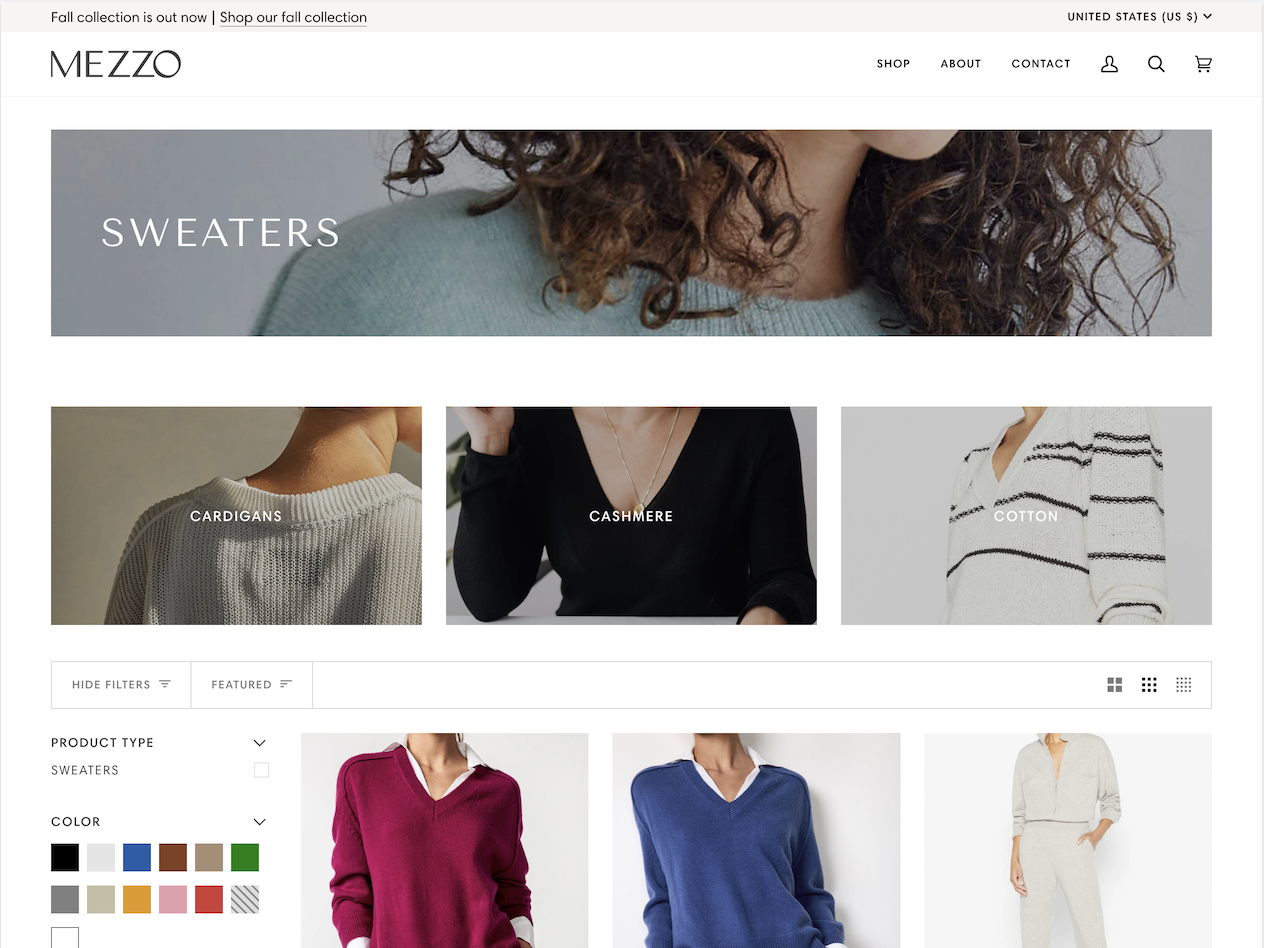
Example of subcollections, we are promoting the "Cardigans", "Cashmere", and "Cotton" collections when viewing the Sweaters collection page:
Another example of using Subcollections can be, to help display additional brands. If a customer is viewing products by a certain brand, you can display product groups of that brand or competing brands.
## Two options in Pipeline
Pipeline offers two methods for adding Subcollections to the Collection template: a fast method and a more flexible method that allows for greater customization.
## Basic method
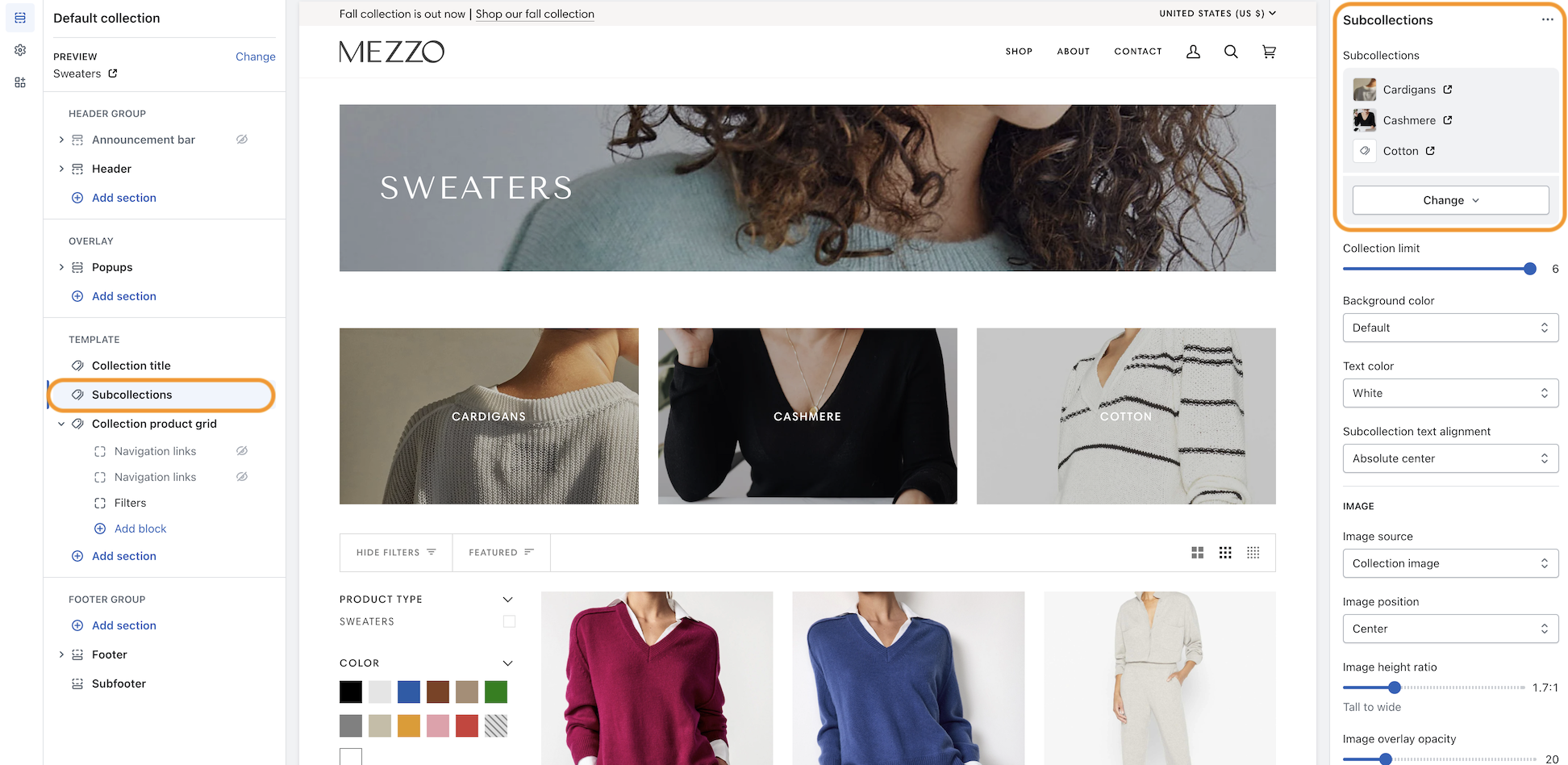
The first method and basic method is to simply choose Collections from the Subcollections list in the Theme Editor (feature added in Pipeline 7):
Using this method will display the same chosen collections on all your collection pages. This might work for smaller stores or situations where you're only promoting the same collections on each of your Collection pages.
## Full customization
Pipeline also supports using a dynamic data source for Subcollections. When you use a collection metafield, you can easily choose which collections are shown for each individual Collection page.
This gives you full customization abilities including showing Subcollections only with certain Collection pages. The setup is fairly simple.
### Step 1
Let's being by creating a Collection metafield in the Shopify Admin.
Choose Settings -> Custom data -> Collections
> *Tip*: Be sure you choose **Collections** when creating this metafield
* Choose the **Add definition** button to start creating the Collection metafield.
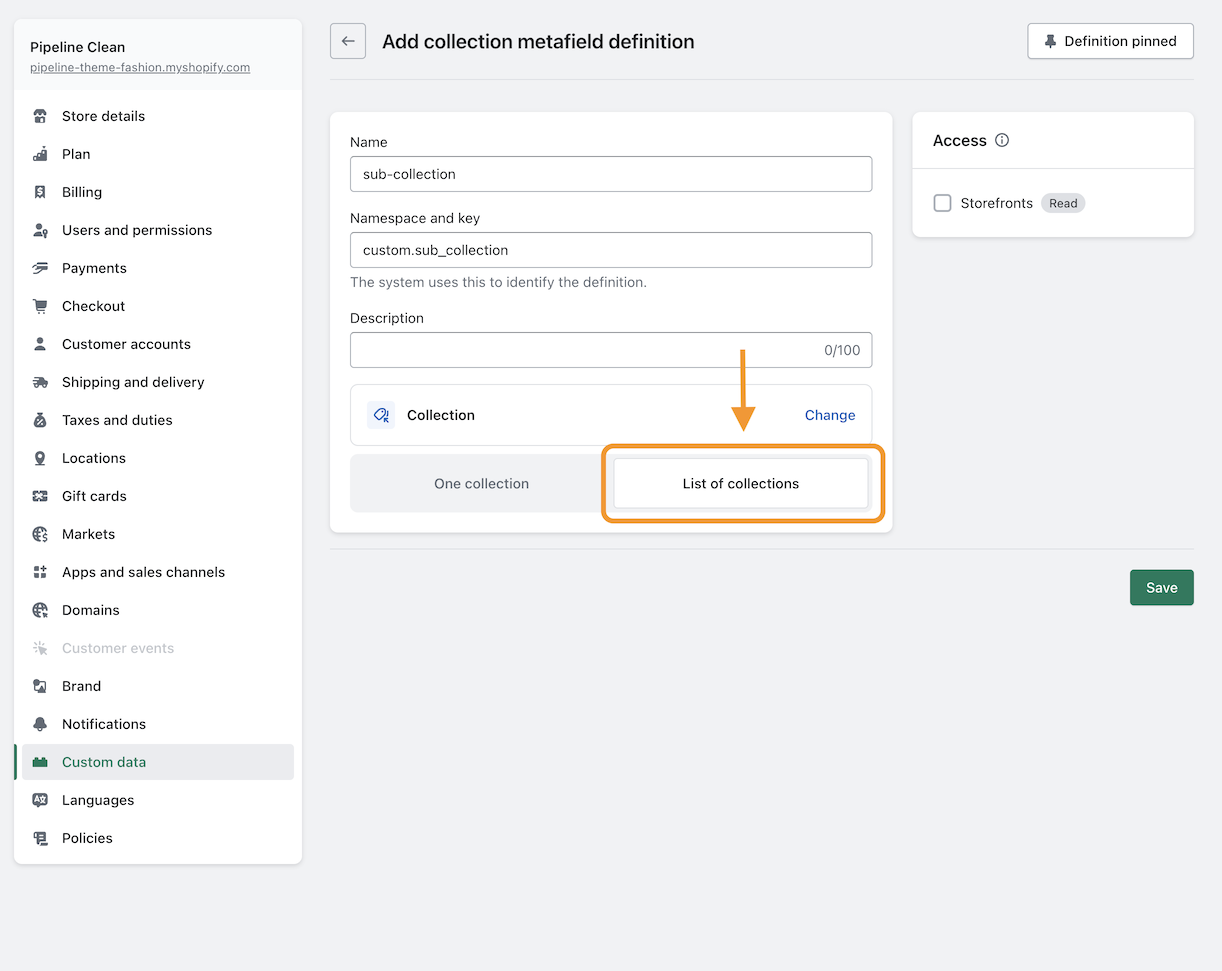
* Add a Name, you can use any name you like for this metafield. We've used `sub-collection`
* After adding a name, you can optionally add a description
* Choose **Select type**, scroll down, and pick **Collection**:
* After choosing Collection, for the type pick **List of collections** (important)
Press the **Save** button to complete
### Step 2
Now we can customize each of our collections with unique Subcollections. Here is a video walkthrough on how to complete our setup and choose individual collection lists:
{% embed url="" fullWidth="true" %}
Steps covered in video
* Shopify Admin -> Products -> Collections, choose a collection, and add a list of collections to cross-promote in the metafields section.
* In the Theme Editor, connect the dynamic data source for subcollections.
You can now choose custom lists of collections for any of your collection pages. Simply return to the Shopify Admin, Collections, and choose a list of collections for any of your existing collections.
---
# Agent Instructions
This documentation is published with GitBook. GitBook is the documentation platform designed so that both humans and AI agents can read, navigate, and reason over technical content effectively. Learn more at gitbook.com.
## Querying This Documentation
If you need additional information that is not directly available in this page, you can query the documentation by asking a question.
Perform an HTTP GET request on the following URL with the `ask` and `goal` query parameters:
```
GET https://pipeline.groupthought.com/collections/collection-pages/subcollections.md?ask=&goal=
```
`ask` is the immediate question: it should be specific, self-contained, and written in natural language.
`goal` is what the user is ultimately trying to achieve, the reason they need the answer. Sharing it helps GitBook give you a better, more relevant answer. A goal is most helpful when it describes the outcome the user wants rather than restating the question. For example, with `ask=how do I create an API token`, a goal like `automate deployments from our CI pipeline` lets GitBook tailor the answer to that use case.
The response will contain a direct answer to the question and relevant excerpts and sources from the documentation.
Use this mechanism when the answer is not explicitly present in the current page, you need clarification or additional context, or you want to retrieve related documentation sections.